

Key Takeaways:
- An expandable hose is a delivery tool for moving water throughout the yard, while a soaker hose is a stationary tool that slowly releases water into a single bed.
- Soaker hoses need low pressure, level ground, and runs of 100 feet or less to water evenly.
- Most gardens do best with both: the soaker handles beds, and the expandable hose covers everything else.
Expandable hoses and soaker hoses are often compared, but they're built for different jobs. One goes wherever you carry it. The other stays put and waters slowly while you do something else. At Pocket Hose, we get asked which one to buy, and for most yards, the answer is that they work best as a team.
How Does an Expandable Hose Work?
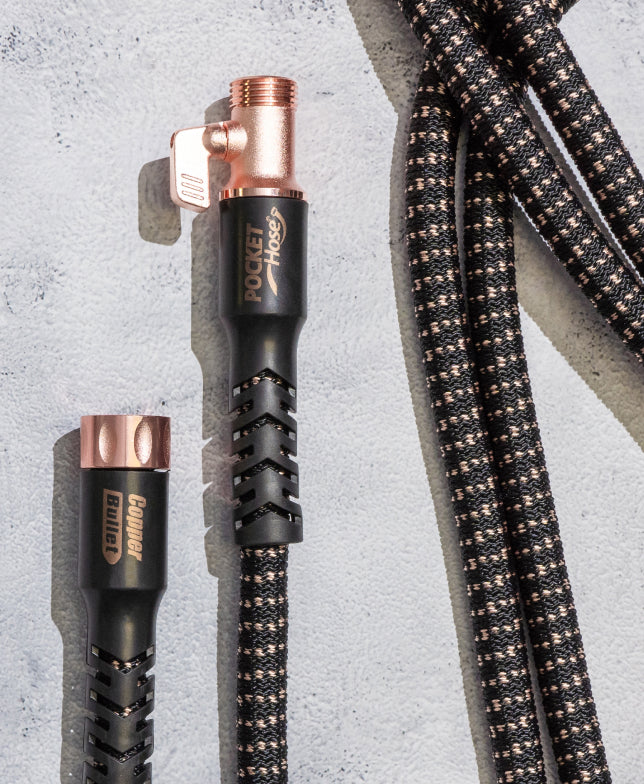
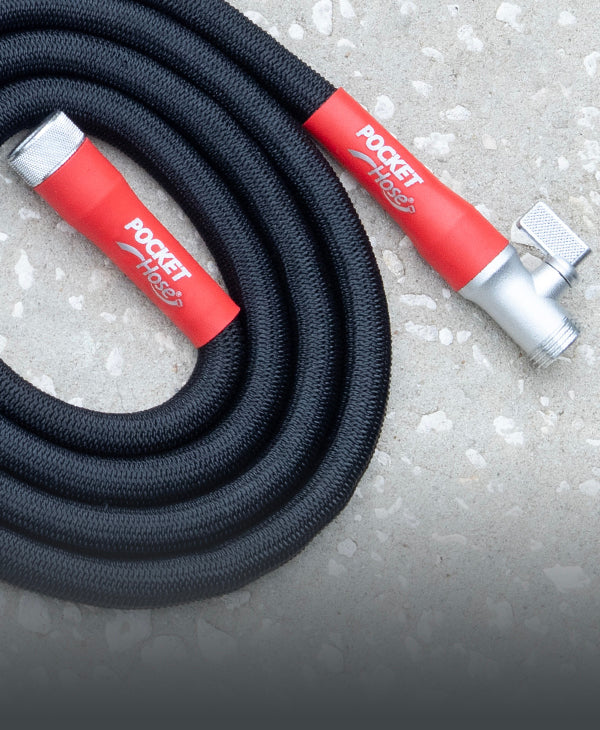
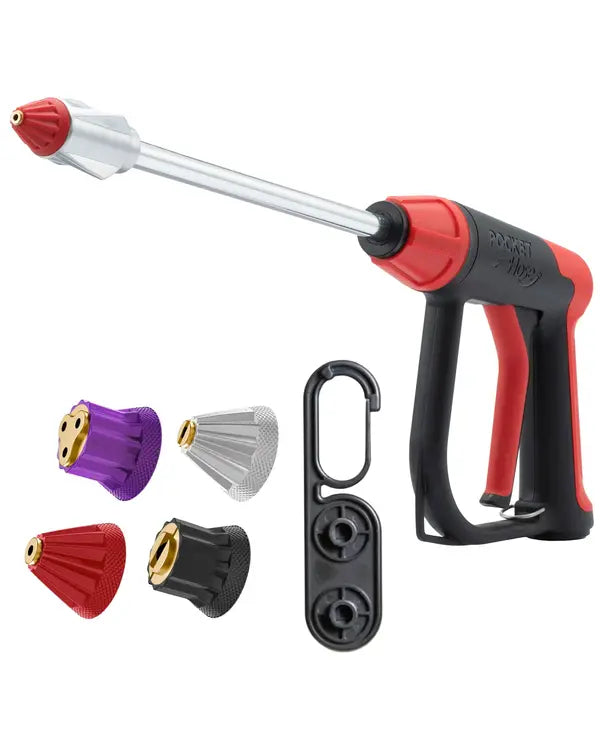
An expandable hose is a delivery line. Household water pressure stretches an elastic inner tube inside a woven outer jacket, and when you shut off the water, the hose drains and contracts to about a third of its length. That design makes it light and easy to carry. A 50-foot Ballistic weighs 2.31 pounds and goes anywhere you walk, from container pots on the patio to the tomato bed at the back fence. You control where water lands with a nozzle, a wand, or a sprinkler. Plus, our Ballistic has a Tri-Tex Triple-Layer Latex Core. Tri-Tex tubing uses three layers of high-strength latex for serious flexibility with confidence under pressure, and is tested up to 650 PSI.
How Does a Soaker Hose Work?
A soaker hose is porous. Water weeps out through tiny openings along its entire length and soaks into the soil right at the roots.
It's a different kind of equipment with its own requirements. Municipal water guidance recommends a pressure regulator of 10 or 12 PSI, runs of no more than 100 feet, and running the faucet just enough for the hose to seep rather than spray. The same guidance notes that soakers work most evenly on level ground and struggle on slopes. Pressure also matters for durability, since soaker hoses may burst at 100 PSI or higher.
Most gardeners lay them on the soil, cover them with mulch, and leave them in place for the season.
When Does an Expandable Hose Make More Sense?
Pick an expandable hose for anything that moves or changes. Hand watering containers and hanging baskets, misting seedlings, soaking a new tree basin, and reaching beds on the far side of the yard all fall here. Soakers aren't a fit for lawns, and guidance on them points homeowners to a sprinkler for turf instead.
An expandable hose also stores easily. It contracts into a bucket or a shelf when you're done, with no reel required.
When Does a Soaker Hose Make More Sense?
Pick a soaker for dense, established beds and vegetable rows that need steady moisture. Because water goes straight into the soil, leaves stay dry. That matters, since some pathogens spread through splashing water and can infect plants while leaf surfaces stay wet. Tomatoes, peppers, and tightly planted perennial borders benefit most.
Soakers also pair well with a timer, since hose timers let you control when a watering session starts and how long it runs. Beds get watered on schedule even when you're busy.
Can You Use an Expandable Hose and a Soaker Hose Together?
Yes, and it's the setup we'd recommend for most gardens. A soaker hose still has to reach the bed from the spigot, which usually means a regular garden hose running between them.
The simplest arrangement uses a two-way splitter at the spigot. Put the pressure regulator and soaker on one outlet and keep your expandable hose on the other. That way, the soaker runs at the low pressure it needs, and your expandable hose gets full household pressure, which it needs to stretch to its full length. Add a timer to the soaker side, and the beds take care of themselves while the hose stays free for everything else.
The Bottom Line: Which Should You Choose?
If you have one or two dense beds and want low-effort, root-level watering, a soaker earns its place. If you need to water pots, seedlings, lawn, and scattered plantings, an expandable hose does the heavy lifting. Most yards have both kinds of needs, so the practical choice is using a soaker where the beds are and an expandable hose everywhere else.
FAQs
Can a soaker hose replace a regular garden hose?
Not usually. A soaker stays in one bed and seeps slowly, so you still need a regular hose for containers, lawns, seedlings, and anywhere the soaker isn't laid.
Do soaker hoses need a pressure regulator?
Yes, in most homes. Household pressure is much higher than the 10 to 12 PSI soakers are designed for, and too much pressure can make them spray or split.
Can you use a soaker hose on a lawn?
It's not a good fit. Soakers are designed for beds and rows, and a sprinkler covers turf far more evenly.
How long should you run a soaker hose?
A common starting point is about 30 minutes twice a week, then check the soil and adjust until moisture reaches several inches down.
Sources:
Soaker Hoses | City of Bellingham
Flower Bed Irrigation Using a Soaker Hose System | UGA Extension Fulton County

Dejar un comentario
Este sitio está protegido por hCaptcha y se aplican la Política de privacidad de hCaptcha y los Términos del servicio.