

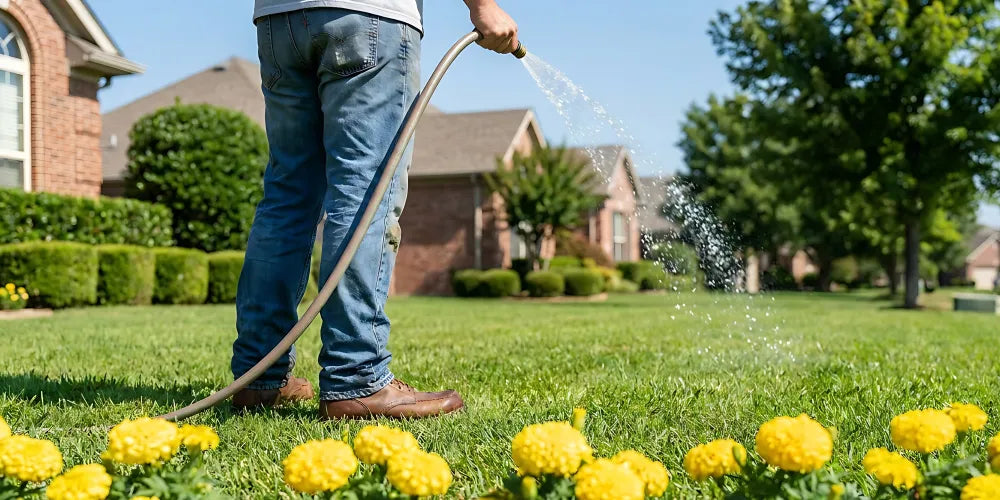
Key Takeaways:
- Most lawns want 1 to 1.5 inches of water per week, split into two or three deep sessions rather than daily sprinkles.
- A few tuna cans and a ruler will tell you exactly how long to run your hose, which removes all the guesswork.
- Working in zones gives you better coverage than an in-ground system does on an uneven yard.
An in-ground irrigation system costs thousands of dollars and gets installed once, whether or not it suits the yard you actually have. The right hose costs a fraction of that and can handle wherever the dry patch is.
At Pocket Hose, plenty of customers water their entire lawn this way, and with a little upfront math, it holds its own against the buried version.
How Much Water Does a Lawn Need Each Week?
The target is consistent across turf guidance. Lawns generally need about 1 to 1.5 inches of water per week, including rainfall.
How you divide that matters as much as the total. Deep, infrequent watering builds a lawn that handles heat, since long soaks send roots downward to moisture that stays stable.
Light daily watering does the reverse and keeps roots near the surface, where they dry out first. Turf specialists put it plainly: never water grass every day unless establishing new seed or sod.
How Long Should You Run the Hose?
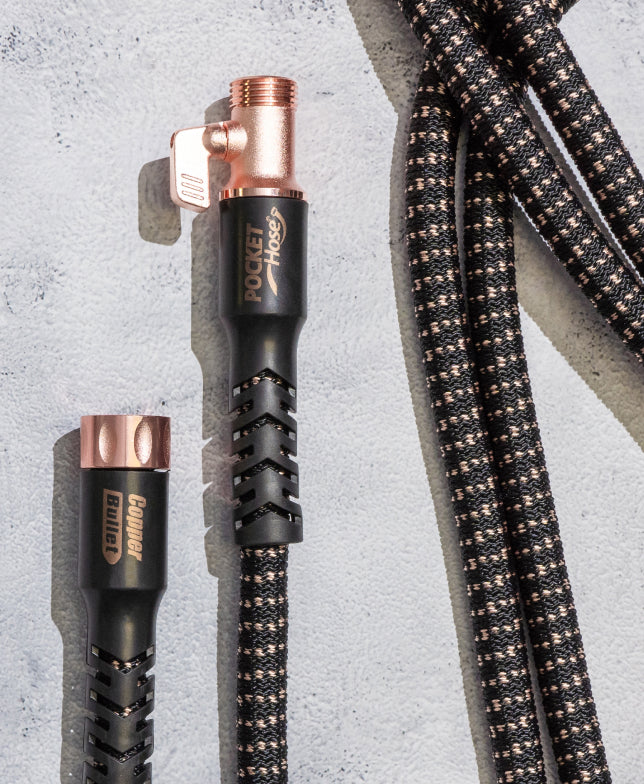
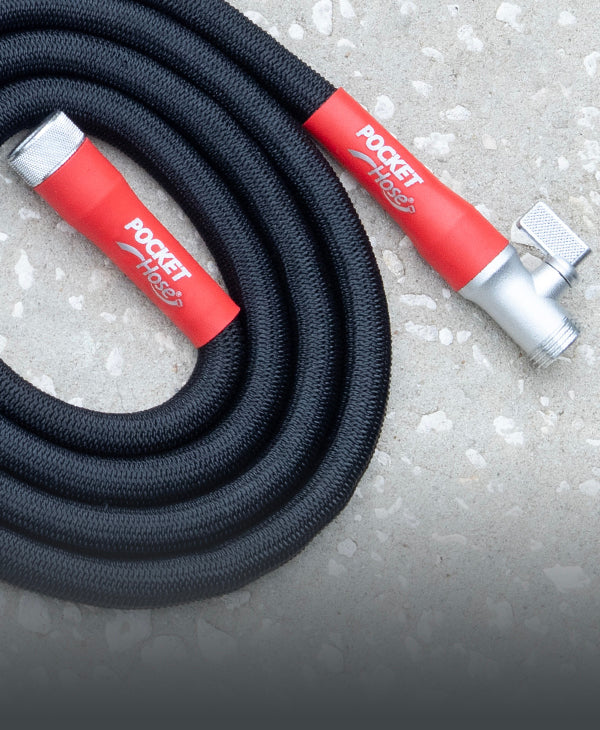
There are two ways to land on a number, and both beat guessing. Start with your hose's output. Fill a five-gallon bucket and time it. If it takes 40 seconds, you're moving about 7.5 gallons per minute. Hose diameter plays a role here, so a full 3/4-inch hose like the Pocket Hose Ballistic gives you more volume to work with than a narrower one. Run your timing test with the hose you’ll actually use, since flow also depends on your home’s water pressure.
Then convert your weekly target into gallons. The standard conversion used in irrigation planning is gallons = area in square feet × inches of water × 0.623. A 2,000-square-foot lawn, therefore, needs roughly 1,250 gallons to receive an inch of water.
Divide that by your flow rate to get your total weekly run time. At 7.5 gallons per minute, that's about 165 minutes spread across the whole lawn, or roughly 20 minutes per zone twice a week if you're covering four zones. Zone watering means dragging your hose to the far corners of the yard several times a week, so reach and weight matter. The Pocket Hose Ballistic comes in 25-, 50-, 75-, and 100-foot lengths, so you can match it to the size of your lawn, and it’s light enough to move from zone to zone without a fight.
If the math isn't appealing, check the result rather than the input. Water one section, then push a screwdriver into the soil every 15 minutes. If it slides in easily, the root zone has moisture, and if the soil resists or you can't get it in at all, it's still dry. Stop once moisture reaches about six inches down and note how long that took. That's your run time from then on.
What Else Affects How Often You Need To Water a Lawn?
Mower maintenance can also affect how often you should water your lawn. A dull blade tears grass rather than cutting it, and torn grass needs 40 to 60 percent more water to recover from each mowing. Sharpening twice a season saves water.
Leaving clippings on the lawn rather than bagging them also keeps moisture and nutrients in the soil.
So, Can You Keep a Lawn Healthy With Just a Hose?
Yes, and the work is mostly front-loaded. Time your flow rate once, run the gallons math once, and you'll have numbers you can reuse every summer. From there, it's two or three deep sessions a week, early in the morning, moving through your zones. You trade some automation for the ability to put water exactly where the yard needs it.
FAQs
How long should you water a lawn with a hose?
Divide your lawn's weekly gallon requirement by your hose's flow rate, then split the result across two or three sessions. For most yards, that lands between 20 and 40 minutes per zone.
Can a hose be as good as an in-ground system?
For most residential lawns, yes, as long as you stay consistent. You give up automation and gain the ability to water problem areas directly.
Can you overwater a lawn?
Yes. Soil that never dries out crowds out oxygen, encouraging shallow roots and disease. Wait for the lawn to show signs of water deficiency before the next session.
Sources:
Watering Your Lawn | Illinois Extension
Watering Lawns | Clemson Cooperative Extension Home and Garden Information Center
Using Graywater for Landscape Irrigation | Texas A&M Irrigation Technology Program
Turfgrass Expert Offers Tips To Keep a Lawn Healthy During Drought | Virginia Tech News

Leave a comment
This site is protected by hCaptcha and the hCaptcha Privacy Policy and Terms of Service apply.